Overcoming Fansipan Mountain
When I get the chance I will return to tell you about our cooking class in Hanoi and share with you one of the recipes. It was a fabulous experience and a great opportunity to learn Vietnamese cooking techniques. But, for now I am going to share with you our climb to the top of Fansipan mountain.
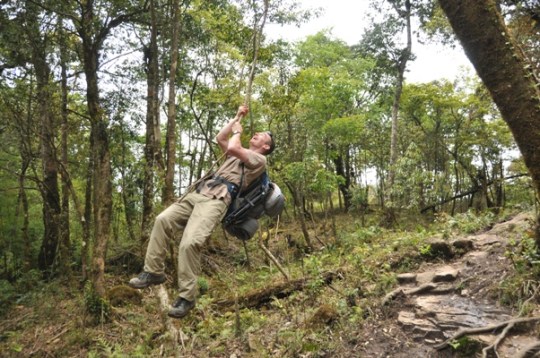
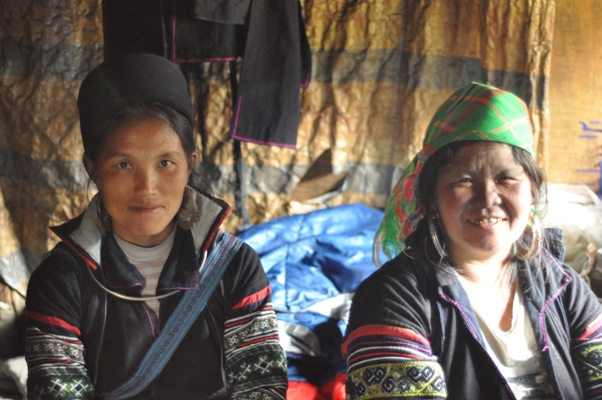
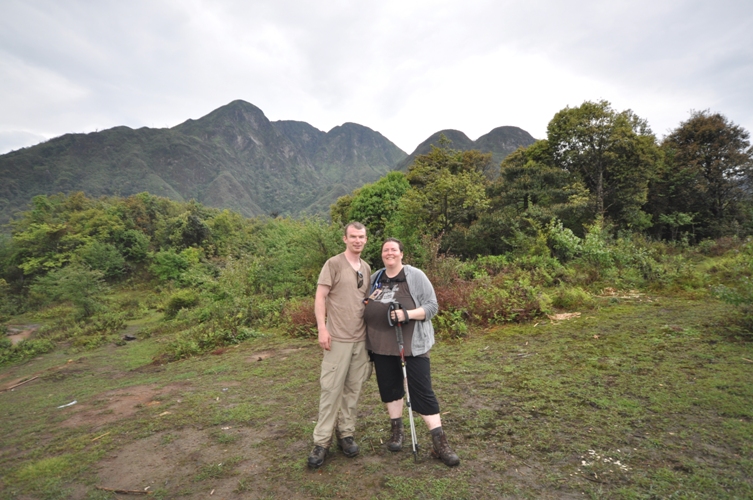
Matt did overcome this mountain! And, I successfully made it to the first base camp at 2200 meters where I decided to stay behind. I had my own very unique experience staying with a HMong tribal woman who did not speak any English. Below is the porter’s wife on the left and the woman who cared for me on the right. She was a jovial woman who spent the day embroidering cloth, cutting fire wood, and cooking.
Sadly, I was unable to conquer this mountain but this is not a walk for the faint of heart. It is for people who are in great physical condition. The hike is steep, straight up rocks, and huge beech tree roots. It is pure untouched jungle with a very narrow walking path and it makes our climb to the top of Ben Nevis seem like a sidewalk stroll through the park!
Thùòng, our English-speaking guide was so amazing. He was patient and understanding taking his time as I slowly made my way to the first base camp. The hike was grueling and challenging right from the first step. The mud was extremely slick and it was easy to lose your footing. The path was a series of steep rock faces that required some scrambling. We made it to the first camp in a few hours but it was difficult walking for me (clearly I’m not conditioned for this kind of extreme climbing). Together, Matt and I decided it was best for me to stay at the first base camp (2200m). He would continue with Thùòng, our guide and Vàng our HMong porter and his wife to the second base camp at 2800m. Thùòng explained that the first section was the easy part and it would continue to get more challenging from there. The first half was too challenging for me and although I am not a person who likes to give up, I humbly bowed out because I feared if I made it up I would not have the strength to return down.
Matt’s journey to the second camp went well and they made excellent time. They made it to the second camp at about 5pm…I know this because they called me on a CELL PHONE…tribal people have cell phones!?! Things that make you go huh?!? Dinner and to bed for both of us in our separate camps.
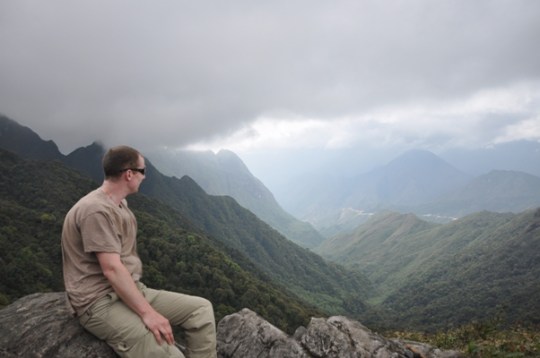
The next morning the boys continued to the top of Fansipan leaving for the summit at about 7:30am on April 27th. It was a beautifully clear day and the sun was shining. Perfect for spectacular views of both Loas and China…but it all just looks like mountain ranges.
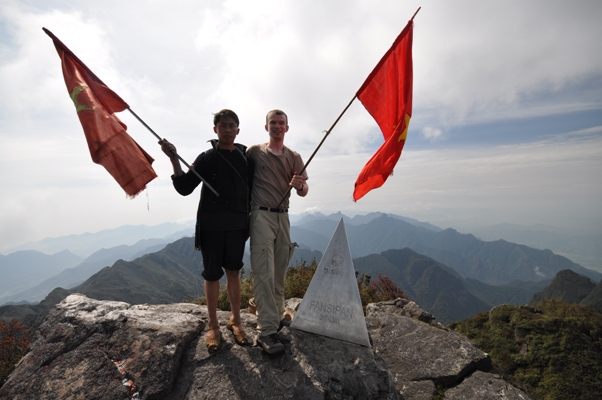
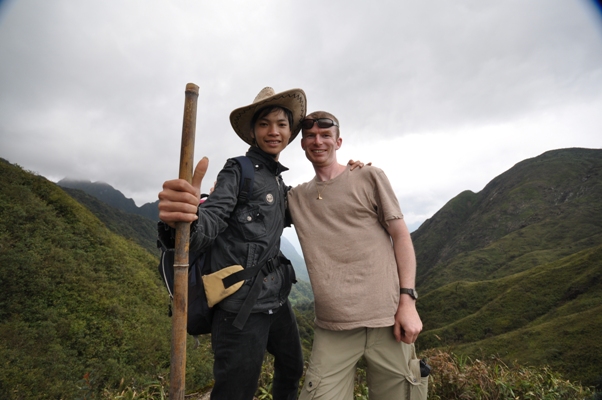
Vàng, our porter and Matt at the top proudly raise the flag of Vietnam. The three boys took time to enjoy the views, take photos, and drink some happy water (rice alcohol). It’s all downhill from here.
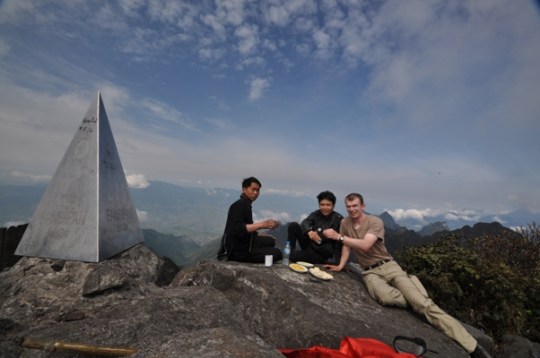
The boys made their way down from the summit to the first base camp to pick me up at about 2pm. During this time many other climbers had passed through this camp. Some hot and winded, others excited about the climb, but most of them were not sure what lay ahead. And, on the horizon ~ rain…my worst fear. I was terrified about making our way down the slick rock face but in the end it was much easier than climbing up. We made it down in good time about 2 hours…YEAH!!!
Love Sapa. The End.
Lunch and Litres at Gambrinus
Okay, it’s 4am our time and Matt and I have both been up since about 2am. Is this jet lag? In all of our travels we’ve never experienced this but there is a HUGE difference between an 8 hour flight and a 20 hour one. It actually makes the 8 hour flights seem like nothing.
Since we’re up and the internet is working well we thought we might share some of our day with you. After doing a 5 hour walking tour in the blazing heat Matt led the way to Gambrinus. It is a Prague-style brew house with cooper vats of freshly brewed beer set up in the center of the establishment. And, it is very popular with the Vietnamese.
We were escorted to the third level and seated by the window. The air conditioning was turned on and several girls dressed in green striped uniforms appeared to set up the table. Everything was positioned just so…the chopsticks unwrapped, the side bowl and plate placed slightly to the right and the coaster squared up on the left. We ordered two .5L of Golden Beer for 68,000 VND which is about $3. It too was placed just right and the girl even checked the head space making sure it met the mark.
Two girls hovered over us while we made our meal selections. It was some what intimidating being watched so closely and kind of made us feel rushed. Oh, well. We settled on Vietnamese Style Grilled Pork with a side of sticky rice.
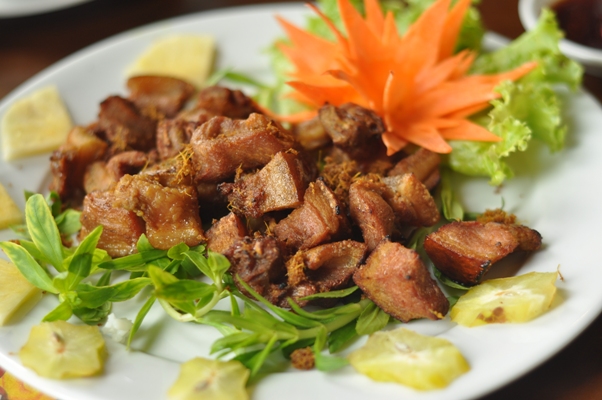
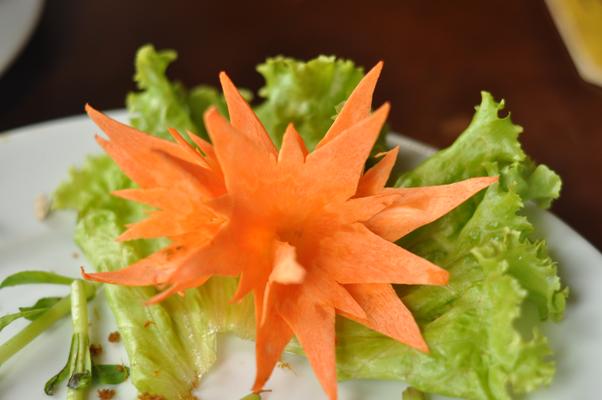
It was tasty morsels, bite size pieces of pork that tasted like crispy bacon. Check out their attention to detail. A flower made out of thinly sliced pieces of carrot?
Matt tried all three of their home-brewed beer ~ Gold (lager), Golden (malty lager), and Stout (dark lager). He concluded that they all tasted exactly the same the only difference was the colour.
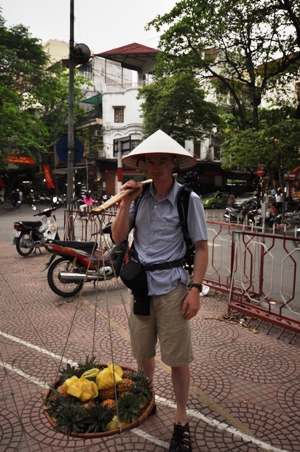
Now that our tanks were back on full we left the comfort of A/C and headed back on to the streets of Hanoi. Matt, a strong-looking chap was offered a job but after giving it a try decided that carpentry was much easier. The strength of the Vietnamese women is unparalleled. They make carrying hundreds of pounds of fresh fruit and veggies look easy.
Okay folks we’re going to try to get a few more hours of shut-eye. We have a big day ahead of us…our cooking class at Highway 4 starts at 8am!
Bun Rieu Nam Bo ~ Vietnamese Soup
We’re here! We’re here! We’re here! After a long and grueling 20+ hour plane ride with a very brief stop over in Hong Kong we’ve made it to Viet Nam ~ our destination for the next 33 days.
The sights and sounds are like nothing we’ve ever experienced. People and motorbikes coming and going in what appear to be highway lanes without speed limits or road rules. We are assuming one of the most important things to investigate when buying a vehicle here is the horn and how many pulsating sounds it can make. Luckily for us our driver’s car horn made at least three different and distinct sounds and he had one hand on it the entire 45 minute ride from the airport to the hotel.
The heat is stifling especially for a couple of Canadians who left snow behind but as the day turned to night a cool breeze set in to make it feel bearable (or was the breeze created by the never-ending stream of motorbikes?)
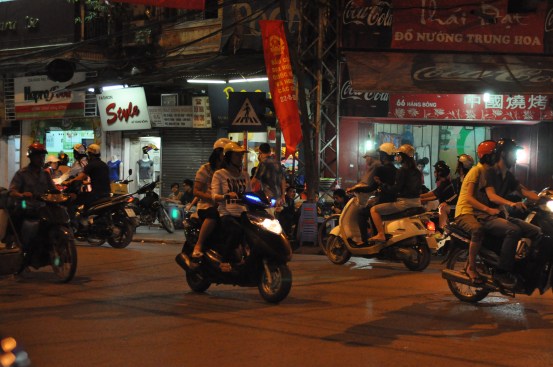
Matt and I walked around for a few hours taking in the never-ending shops, the narrow sidewalks (if you can call them that), the women peddling donuts and fruit, the constant stream of vehicles and the fact there are no cross walks…you just walk out into traffic slowly (better with eyes closed) at a steady pace and fingers crossed the cars and bikes slow or swerve to miss you! It is very different from any place we’ve ever been and culturally a lot to take in.
Now, onto the bun rieu nam bo (soup) we stopped to enjoy at a street shop on the corner of Hang Bang and Phu Doan. It was delicious! We didn’t know what to order and just let them bring us what they were serving. It was a busy place with the locals so we assumed the food was good.
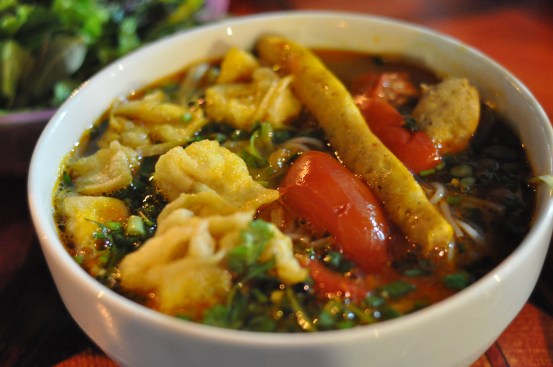
It was only after we sat there for a while enjoying the soup and a few cold beers that one of the young girls (fascinated with all of my coloured pens) came over to give us a lesson in writing and speaking some common Vietnamese phrases. She told us the name of the soup along with “bia danh” which means cold beer and other phrases like xin chào – hello, taim biêt -bye bye, càm òn – thank-you and a number of other words. She went over and over the words asking us to repeat them and giggling with her friends as we stumbled through the very different sounds. The trade for this lesson was one of my new pens. We paid and headed back to our hotel. Phew, we made it through our first day and should be on Vietnamese time (11 hours ahead) tomorrow.
Food, Fare, and Fun in VIETNAM!
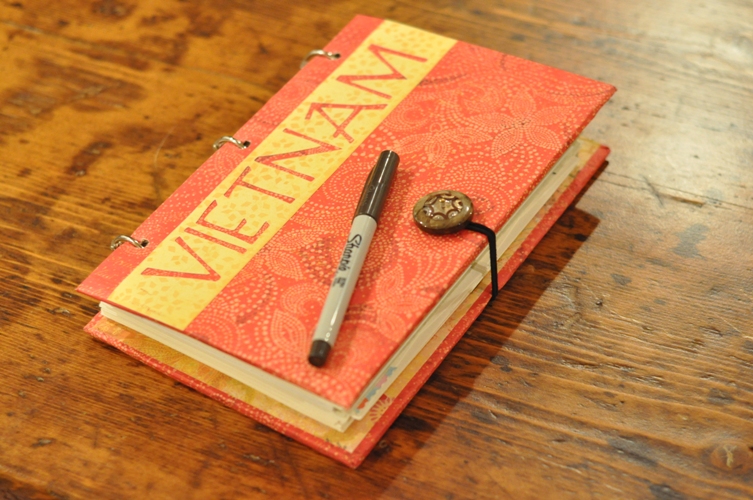
Okay, I guess it’s time to break it to you…Matt and I are heading to Vietnam. We leave in just a few more sleeps and will be gone for just over a month. YEAH! Are we excited? Yes! A little nervous too. But, once we board the plane there is no turning back and I know we’ll have an amazing adventure. One that we will remember for years and years to come.
For the last few years, Matt and I have been travelling the world one country at a time. I love it! There is nothing greater than experiencing a new culture, tasting different foods, enjoying exotic surroundings, and the history…oh, the history. The entire experience makes me feel thankful. I’m thankful we have the opporunity to travel, grateful my mom is willing to love and care for our 8 boys (the four legged kind), blessed to have someone to share it with and delighted by all of the wonderful people we’ve met along the way (some of whom we still keep in touch with). Travelling broadens your horizon and reminds us this big world of ours is a very special and beautiful place that we all need to take better care of. It opens your mind in ways you didn’t know were possible and makes you more accepting of other people. It is truly a gift to go outside of your comfort zone and embrace a new country, a new culture, and a new way of life.
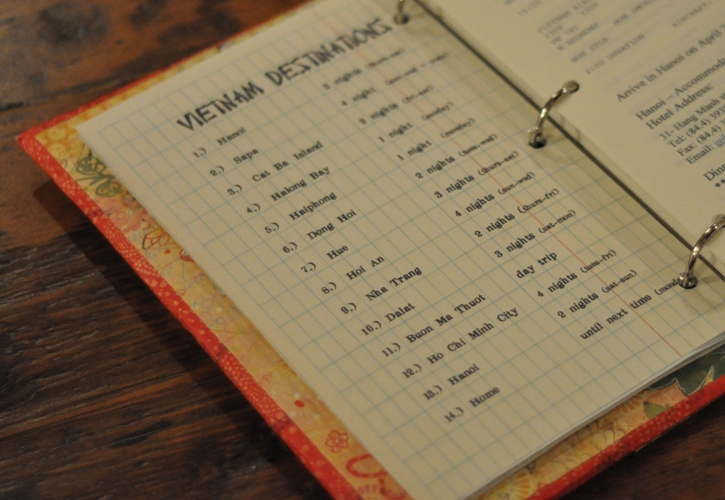
When we are able to gain free wi-fi and if it is not unbearably slow we will give you the occassional update. A lot of our trip will revolve around food. We will be taking a cooking class in Hanoi. Cooking…well, I’m not sure but Matt’s excited. The part of the class that interests me is the trip to the market to learn what and how to purchase fresh ingredients. Did you know they produce one of the world’s best peppercorn? Apparently, once you’ve tried it you are ruined. And, for Matt (the coffee snob) there is coffee beans that come from the digestive system of the Weasel? Now, it’s no Kopi Luwak but interesting just the same! These are just a few of the many things we plan on experiencing while visiting Vietnam.
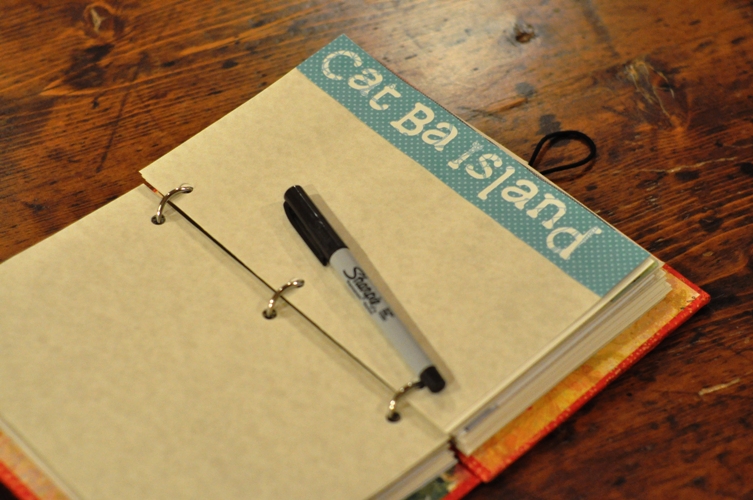
I’ve made this jazzy journal (using my new cricut) to keep track of the people we meet, the places we go, and all the cool stuff we do. So, if you’d like to see Vietnam through our eyes keep checking back for updates!
Sugar Sand ~ Chalk it up to Learning Experience
We are done, finished, complete. Another year of maple syrup making under our belts and it was our largest haul to date. We collected approximately 200 gallons or 800 litres of sap which was transformed into an amazing 5 gallons or 20 litres of syrup. Yeah!
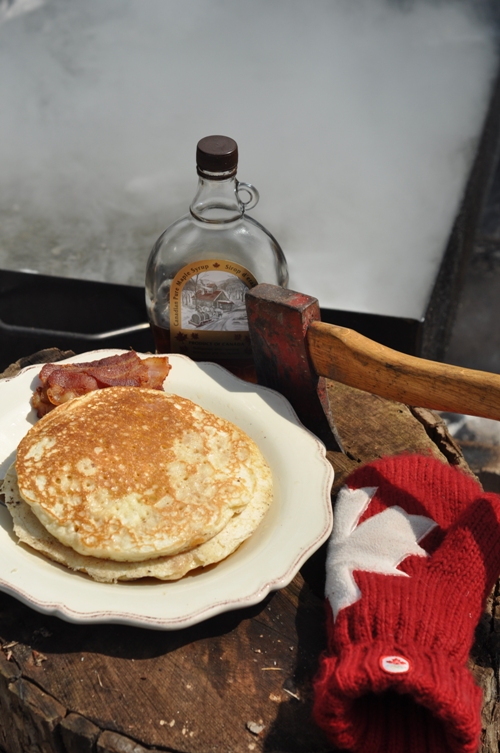
Our trees ran well all week, producing approximately 100 gallons of sap. It was a sizable boil that was going to take some time and patience to reduce. On Saturday, Matt made a delicious pancake breakfast (smothered in some of last years maple syrup) that we enjoyed in front of the warm fire.
Things were going smoothly but we could tell it wasn’t going to be finished until the next day. Matt got up twice in the night to stoke the fire and I got up Sunday around 5:30 to get it boiling hard so that we could finish before the rain moved in.
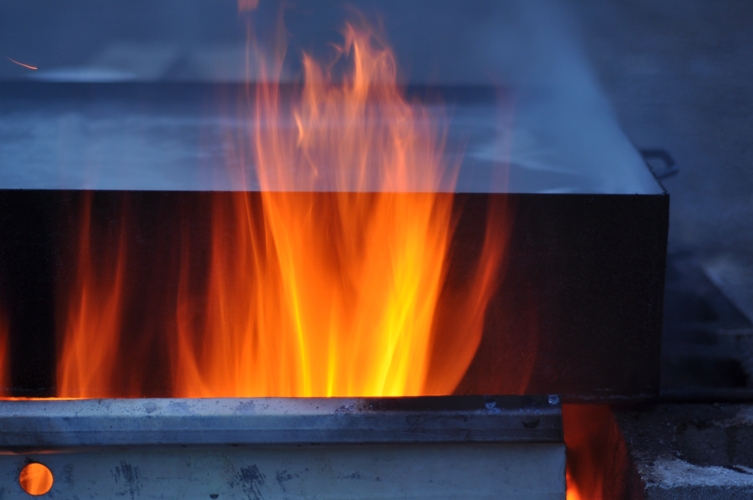
Our pan is the perfect size for finishing the amount of sap we collect from 20 trees. Outside, we brought our sap (now syrup) up to 218-219F, poured it through the wool filter into a large stainless steel pot, and brought it inside. It filtered quickly and we were certain this was going to be our clearest batch of the season.
However, I’m here to report that we made one huge mistake that created the sugar sand deposits that are now present in every bottle. Inside, we placed it back on the stove and returned the syrup to 219F. It’s nice to hold it at 219F for a few minutes to thicken the syrup up but be careful not to let the temperature rise any further. Note: We always bring our filtered syrup inside and reheat or boil it to the finishing temperature of 7.1degrees F above the temperature of boiling water (for us approximately 219F). It is very difficult to be sure that it has reached the proper temperature in the large outdoor pan.
The second reason we like to finish it inside is so we can be sure it stays as hot as possible during the bottling process. Bottling must be done quickly and efficiently because the syrup temperature must not go below 180F (this ensures sterilization and prevents mold). It reached 219F quickly, we held it at that temperature for a minute or so, and then laddled the syrup into hot (out of the oven) sterilized bottles.
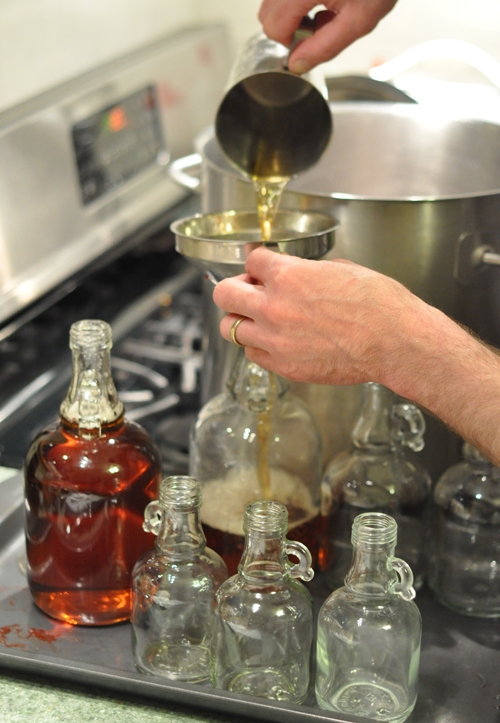
We didn’t know until much later in the afternoon that there was a bunch of sugar sand collecting on the bottoms. Why? How could this be? What did we do wrong? We filtered it through the wool clothe and pre-filters. Should we have used more pre-filters? Disappointed and determined to get to the bottom of this problem I went online and found that other people were having the same trouble.
This is what we’ve concluded…after bringing the filtered syrup inside and returning it to 219F we should have re-filtered it. Why? Because more sugar sand or niter was created by bringing it to temperature. Sugar sand accumulates as sap boils. It’s a concentration of minerals and nutrients that collect as the excess water is boiled away. It is perfectly harmless and can be consumed. In fact, some maple syrup producers are unable to eliminate it completely even when using a filter press. But, after reheating it, we should have filtered it a second time before bottling. This is the one step we omitted and did so because we were confident that it was clear and well filtered initially. We didn’t know that by reheating it we were creating more niter. In the past, we have always filtered it again after bringing it up to temperature because our initial filters were so gunked up; not even realizing how critical this final step was in reducing the sugar sand or niter. Let this be a lesson learned.
But my question to you is, “why does this always happen with the largest batch? Why couldn’t it have happened with the initial 6.35 litres?”
Put up Total:
- 6 x350mL
- 17 x 500mL
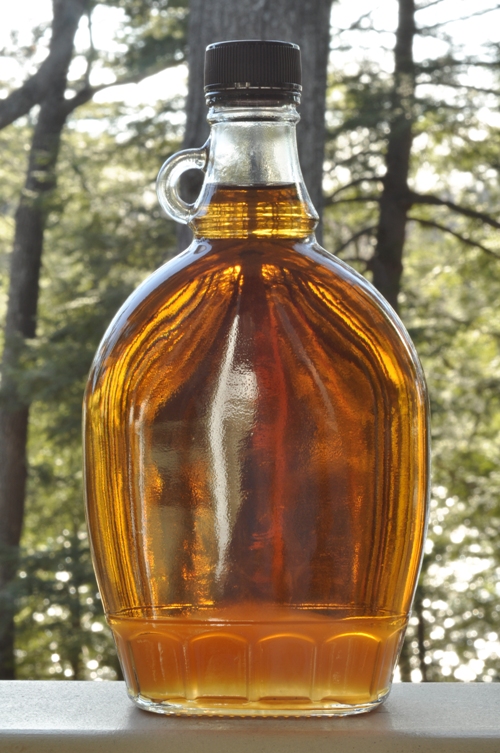
The one nice thing is this syrup is still really light even though it is our third batch. Usually, the final boil produces much darker syrup but all three of our batches were fairly light with this one being the lightest. Despite the sugar or sap sand floating on the bottom (and, it will settle in a week or two) it is as heavenly as the rest and will be enjoyed by family, friends, and neighbours for the next year!
Canning 101: Fruit Float
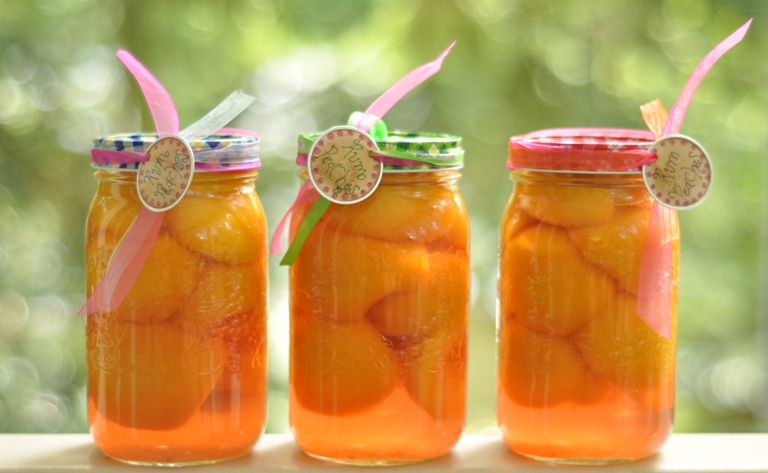
Recently one of our readers asked us, “When canning strawberries or peaches in syrup, or even tomatoes packed in water, why do they float in your jars?” We thought this was a great question that required an explanation.
Many of us have experienced fruit float when canning whole fruits and some vegetables. It’s not attractive and if given a choice we’d probably all prefer if our fruit co-operated and did as it’s told…that is sink to the bottom, submerged in liquid. But, sometimes this just doesn’t happen and we are left wondering “Why? Is it safe to eat? And, what could we have done to prevent it?’
Firstly, the good news, it is perfectly safe to eat. Fruit float will not affect the taste or the shelf life of the preserve (as long as proper canning practices were followed). But, don’t you still wonder why it happens and if there is anything that can be done to prevent it?
Here are a few suggestions that may help to prevent future buoyancy problems.
- Select fruit that is fresh, firm, unblemished, and ripe. A few years back, we purchased multiple boxes of peaches that were seconds. At half the price we thought it was a steal but they caused us 10 times more grief and ended up floating like crazy. They were all at different stages of ripeness with bruised areas which made it challenging to slip off the skins. Plus, over ripe fruit does not absorb enough sugar causing them to float in the jars.
- Use the hot pack method. While both the hot pack and cold pack methods are used to can whole fruits and vegetables, the hot pack method may help to prevent fruit float. The hot pack method requires the fruit to be heated through before packing into hot sterilized jars. This method helps to expel the air that all fruits contain, making them more dense and less likely to float to the surface. Heating them through also shrinks the fruit (slightly) allowing jars to be packed tightly; again, helping to prevent the fruit from floating. The cold pack or raw pack method of preservation allows fruits and vegetables to be packed without heating but it requires a longer processing time. During processing, the air in the fruit or vegetables will be cooked out causing them to shrink in size and create more room in the jars which allows them to float to the surface.
- Packing jars. Be sure to pack the fruit tightly in each jar without crushing the pieces. Remove all air bubbles and top up with additional fruit and/or liquid. Some shrinkage will occur during processing so fruit that is well packed in each jar is less likely to have the space and/or room to float.
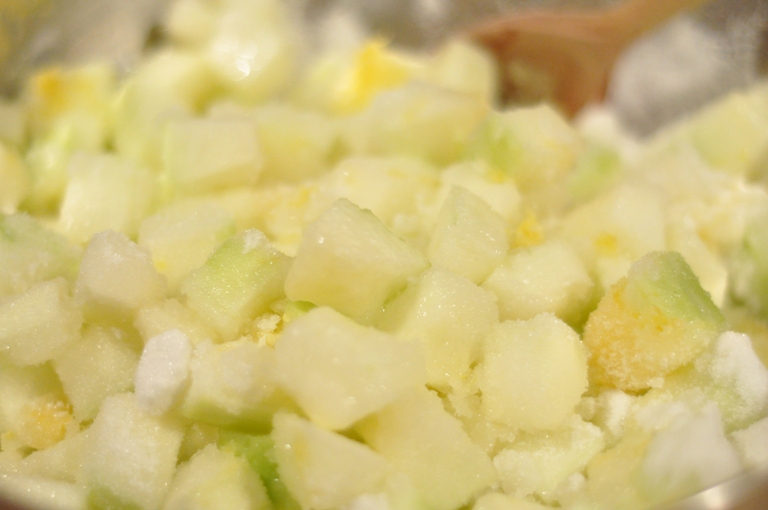
- Sugar content. Some fruits like apricots, rhubarb, and berries naturally have more air in their cells which makes them more buoyant. Coating these fruits in sugar and setting aside allows the fruit to absorb the sugar and expel some of the water to make the fruit more dense.
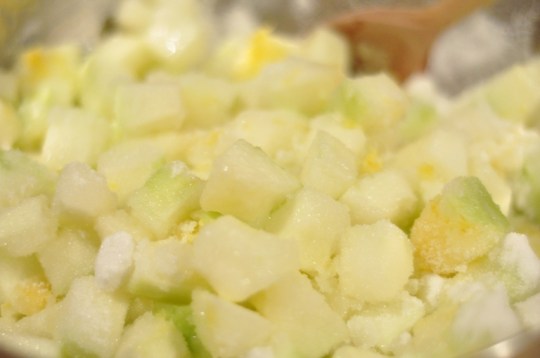 Heavier, more sugary syrups may cause fruit to float. Why? Light syrup, juice syrups, or water packed fruits/vegetables are in an environment where the fruit/vegetables are equally as dense as the liquid, diminishing buoyancy. Fruit in a heavier syrup is lighter than the liquid and therefore may float. Note: We pack 90% of our fruits in a very light syrup and will still occasionally experience fruit float.
 - Follow processing times carefully. Over processing fruits and vegetables will destroy cell structure, making fruit lighter and more likely to float.
Although, it may be impossible to prevent fruit float every time, the above suggestions should help. And, sometimes understanding why something is happening is enough.
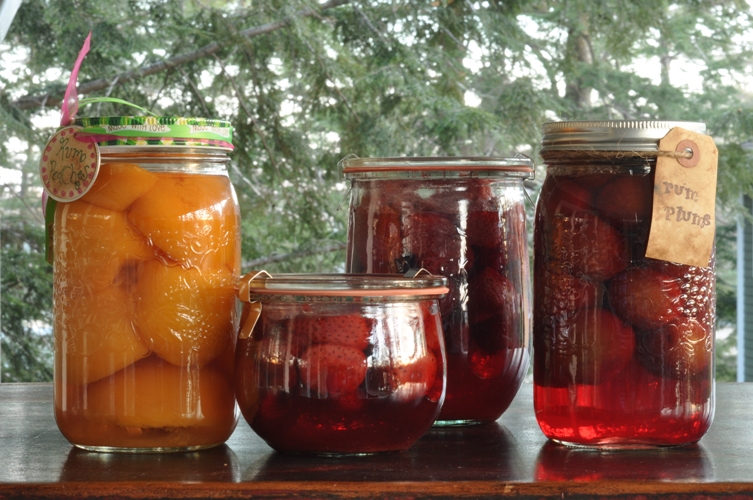
The peaches on the left are fine but both the strawberries (center) and the plums (left) have fruit float. But, we guarantee they all taste yummy!


 Putting Up With The Turnbulls