Pickled Rutabaga Strips
Canadians and Americans use the term Rutabaga, while Australians use the word Swede, the Irish refer to them as Turnips, and the Scots call them Neeps (I think the Scots say it best). Whatever you decide to call this root vegetable one thing is for sure it can be prepared in a variety of ways.
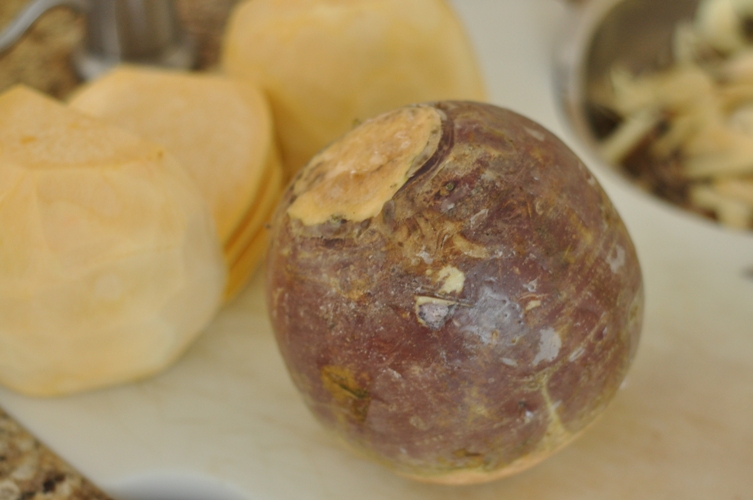
This recipe comes from Liana Krissoff’s book Canning For A New Generation. Like so many of her preservation recipes, Liana takes a common ingredient and puts her unique spin on it showing us that canning is anything but ordinary.
RECIPE FOR PICKLED RUTABAGA:
- 3 pounds rutabaga, peeled, quartered, and cut into 1/2 inch strips
- 1/4 cup plus 1 teaspoon pure kosher salt (we required an additional 1/4 cup of salt to cover the rutabaga)
- 1/4 cup strained fresh lemon juice (about 1 large lemon)
- 4 teaspoons cumin seeds, toasted (I missed the toasted part)
- 2 teaspoons paprika
- 1/4 teaspoon ground cayenne
- 3 cups cider vinegar (5% acidity)
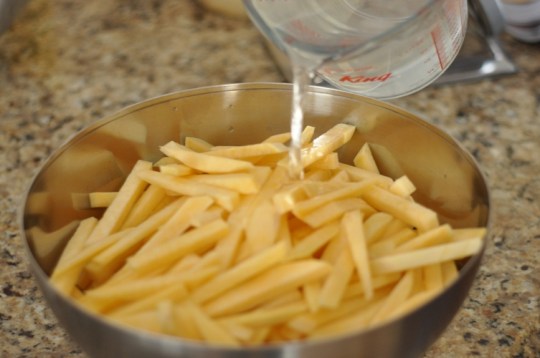
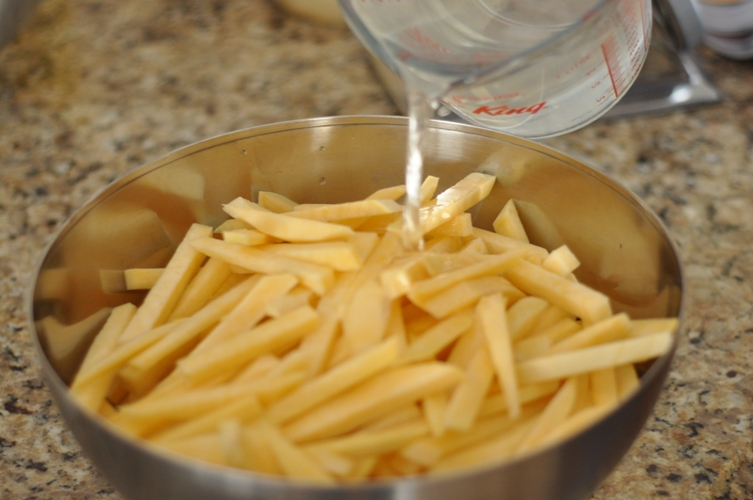
- Wash, peel, and cut your rutabaga into strips. Place the rutabaga strips in a large bowl. Dissolve the 1/4 cup salt in 1 litre of water, then pour the brine over the rutabaga to just cover them. This amount of salted water did not cover the rutabaga so we doubled the amount of salt and water. Leave to stand for 8 to 10 hours, or overnight.
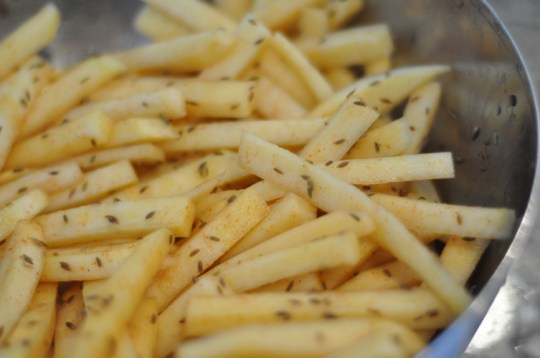
- Next day, drain the rutabaga, then add the lemon juice, toasted cumin seeds, paprika, and cayenne. Mix well to ensure the strips are covered in the seasoning. Set aside.
- Prepare for water bath canning. Sterilize jars in the oven at 250F for 20-30 minutes.
- In a stainless steel saucepan, combine the vinegar, 1 cup water, and the remaining 1 teaspoon salt. Bring just to a boil.
- Working quickly, pack the rutabaga into hot sterilized jars, and equally divide any juice remaining in the bottom of the bowl.
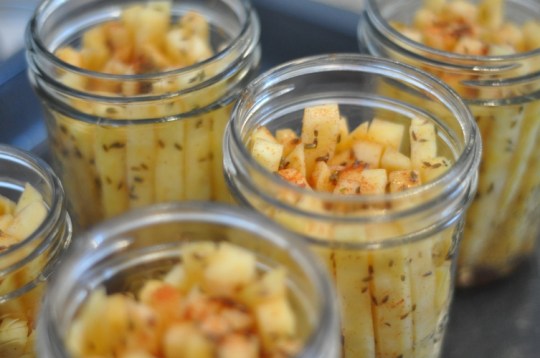
- Ladle the hot brine into the jars, leaving 1/2″ headspace. Remove any air bubbles (there were lots of bubbles) and if necessary, adjust headspace by adding more of the vinegar mixture .
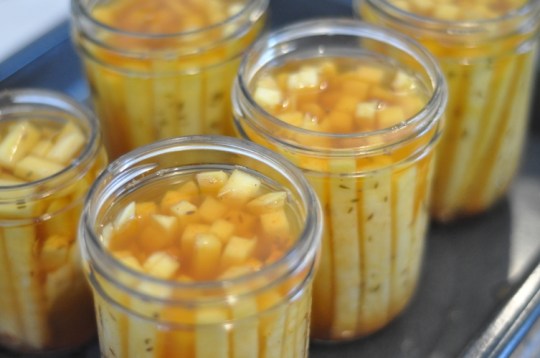
- Wipe rims using a damp paper towel. Center lid on jar and screw band down until resistance is met and then adjust to finger tip tight. Place jars in hot water bath ensuring they are completely submerged. Bring to a full rolling boil and process for 15 minutes. Turn off heat, remove lid and let stand for 5 minutes before removing jars. Check seal, label, and store. Refrigerate any unsealed jars.
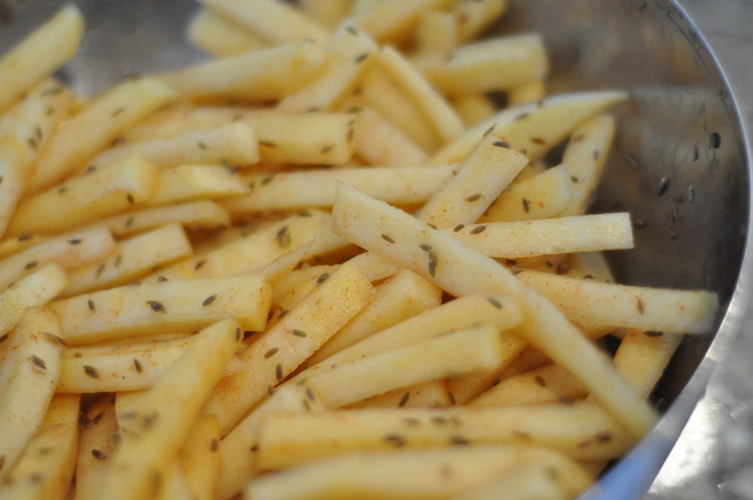
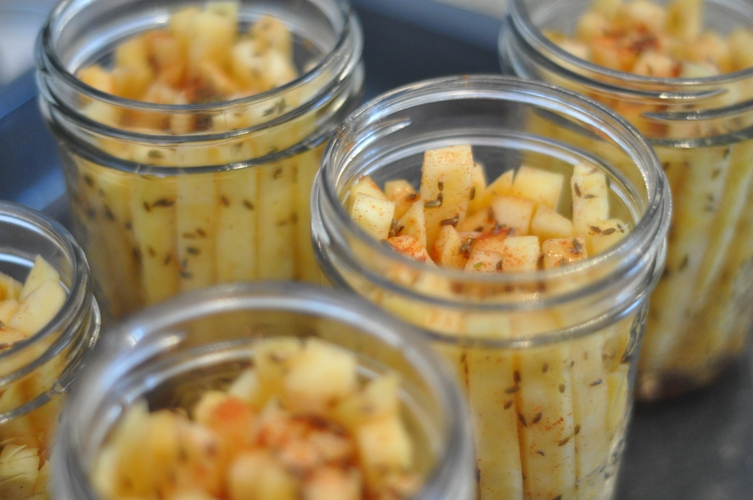
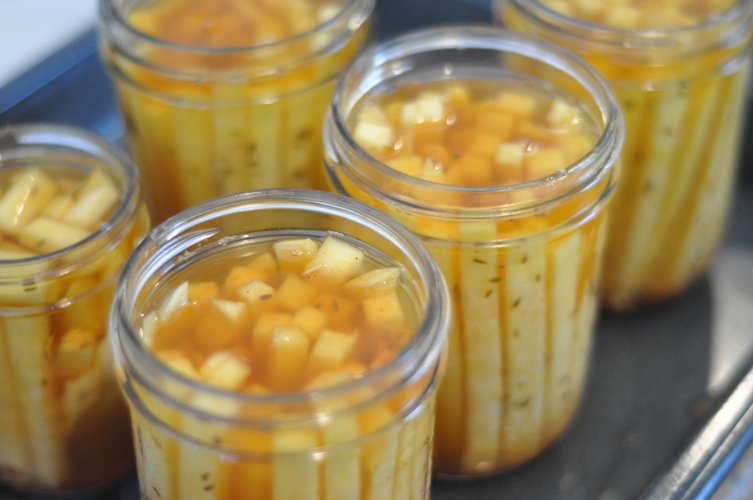
With little flecks of cumin seeds floating about, these golden-yellow rutabaga strips look like they are glowing in the slightly orangey vinegar. If they taste as good as they look we will consider it a success and possibly make a second batch before the winter is over.
Liana recommends using this pickle as a side for hickory smoked pork but I can see us setting a jar out on our bar counter for friends to nibble on as they put down a pint.
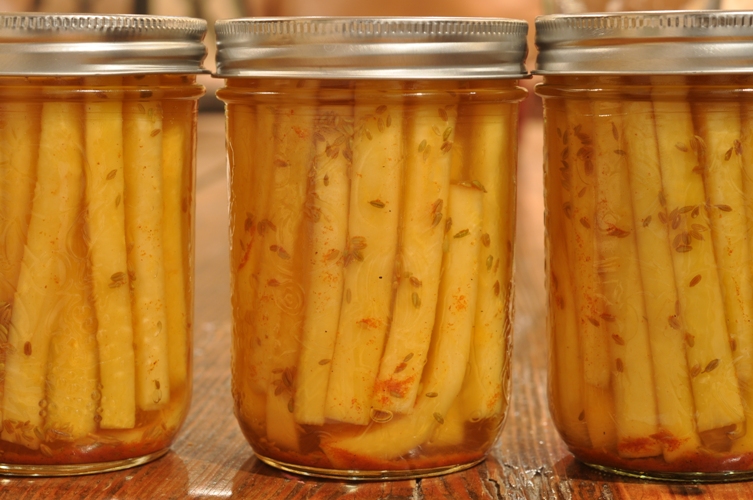
I think this is a great recipe for first time canners to try before we get into the throes of canning season this spring/summer. It is relatively easy and will get your feet wet and ready for some water bath canning. The hardest part of this pickled preserve is peeling and cutting the rutabaga (they’re tough and solid guys which require a good knife and an experienced hand). Matt made it look easy.
Put up Total:
- 1 x 250mL regular mouth mason jar
- 4 x 500mL wide mouth mason jars
Second Batch – made February 1, 2011
- 3 x 500mL wide mouth jar (the 4th jar broken well processing)
Side Note: this is more for my records than anything else…Canned a 2nd batch of Bloody Good Marmalade.
Put up Total:
- 5 x 250mL regular mouth mason jars
Chestnut Spread
This chestnut spread did not turn out as expected. In fact, I thought it was going to be a creamy vanilla white colour with a smooth peanut butter like texture but instead it is a crunchy, crumbly, sugary spread that is more like a nut topping than a spreadable jam. At first, I thought it was a complete failure but Matt assures me “all is not lost…it has great flavour and will add something special to coffee cake.” Phew…I feel much better!
The chunky texture may have something to do with the freshness of the chestnuts or this may just be the nature of the nut. But, like so many recipes with few components, the success or failure comes down to selecting the freshest ingredients and putting them up as soon as you get them. I suspect these chestnuts sat around the store for a month longer than they should have. Even as I was shelling them I found several that were spoiled.
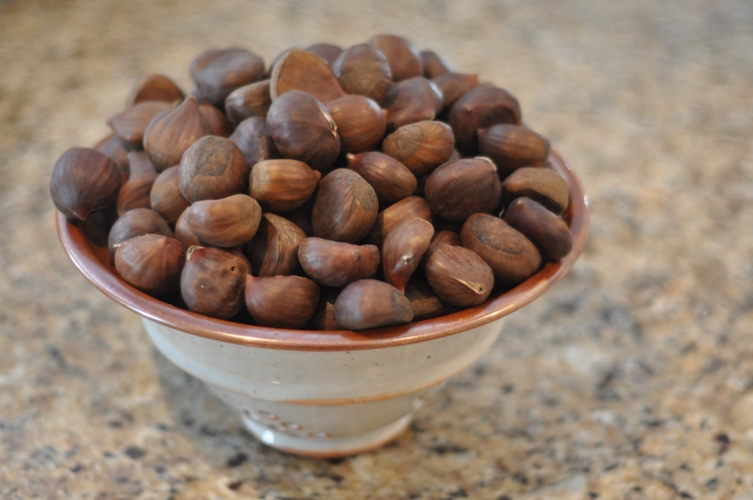
This recipe comes from Christine Ferber’s book Mes Confitures and I modified it slightly to add a little citrus and some hootch (rum), two flavours that compliment the natural sweetness of chestnuts.
RECIPE FOR CHESTNUT SPREAD:
- 2 3/4 pounds chestnuts, or 1 3/4 pounds net
- 4 2/3 cups granulated sugar (I think it’s a bit too much sugar and it may be nice to cut the sugar back and use some chestnut honey as well)
- 1 3/4 cup water
- 1 vanilla bean (I used an organic bourbon vanilla bean)
- zest of 1 orange (I juice the orange and keep a bottle of fresh squeezed orange juice in the fridge to use in other preserving projects)
- 4 tbsp of rum (I used Angostura 1919. It is a sweet rum that reminds me of cotton candy)
- Make a deep cut in each chestnut (from the top to the bottom) with the point of a knife to cut through its two skins. Put chestnuts in boiling water. After 3 minutes, you will be able to remove the outer shell and the inner skin. The chestnuts are relatively easy to peel if they are hot but once they cool off the inner skin becomes very difficult to remove. Do this step in stages or with a friend only boiling a handful of chestnuts at a time so that you can quickly remove the two skins before they cool down.
- In a preserving pan, combine the chestnuts, sugar, water, and vanilla bean, split lengthwise.
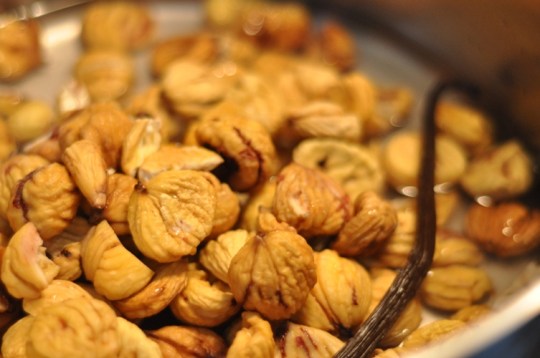 Bring to a boil and then reduce heat to cook for about 15 minutes, stirring gently. The chestnuts will be soft. Pour the mixture into a ceramic bowl. Cover with a sheet of parchment paper and refrigerate overnight.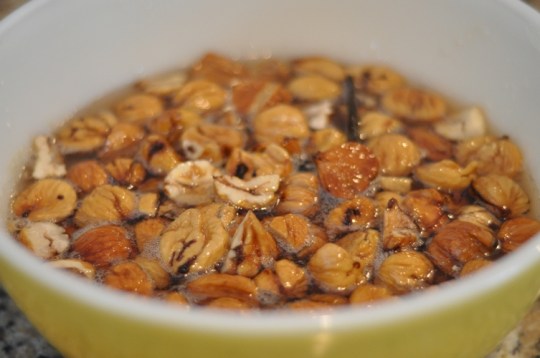
- Next day, bring this preparation to a boil, stirring constantly. Note: My mixture was rock solid, the sugar had crystalized, and the chestnuts were very hard (it may have been overcooked the day before or my fridge too cold). Skim if need be.
- Crush the large pieces of chestnut with a wooden spoon. Remove the vanilla bean while crushing or blending the nuts. Again, the chestnuts were too hard (even after heating) to crush with a spoon. The mixture was transferred into the cuisinart to break into fine pieces.
- Add the orange zest and rum to the mixture. Combining well.
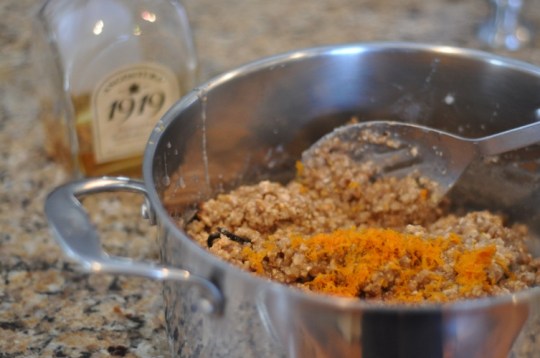 Continue cooking on low heat for about 10 minutes, stirring continuously. Cooking for 10 minutes was unnecessary as my mixture was already thick and well set (for this reason, I believe it was overcooked the day before). I reheated it so that it would be hot when it was ladled into the sterilized jars.
 - Remove the vanilla bean and cut a piece to go into each jar. Ladle hot spread into hot sterilized jars leaving 1/4″ headspace, wipe rims, place lid and ring to finger tip tight on each jar and process in hot water bath for 10 minutes. Turn off heat, remove lid and let stand for 5 minutes before removing jars. Check seal, label, and store.
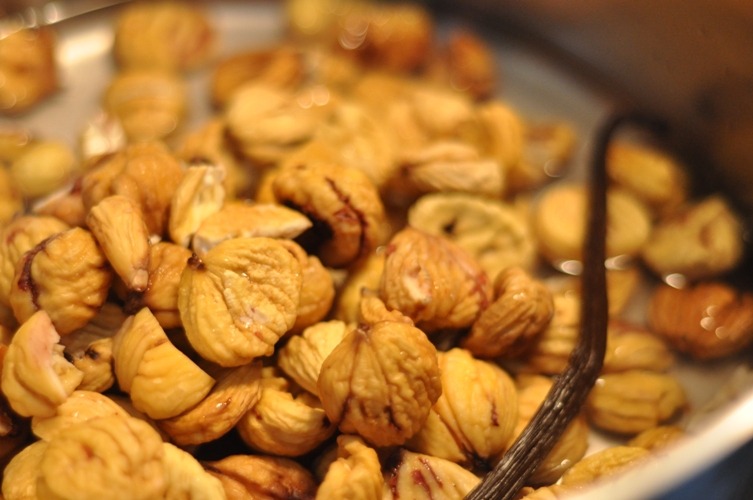
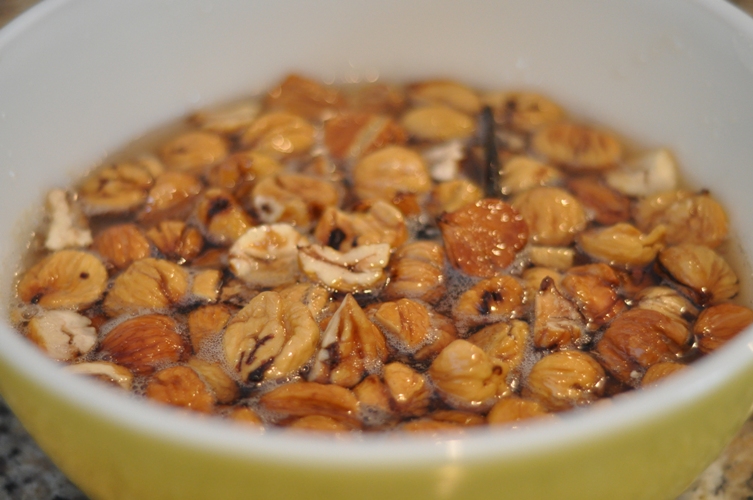
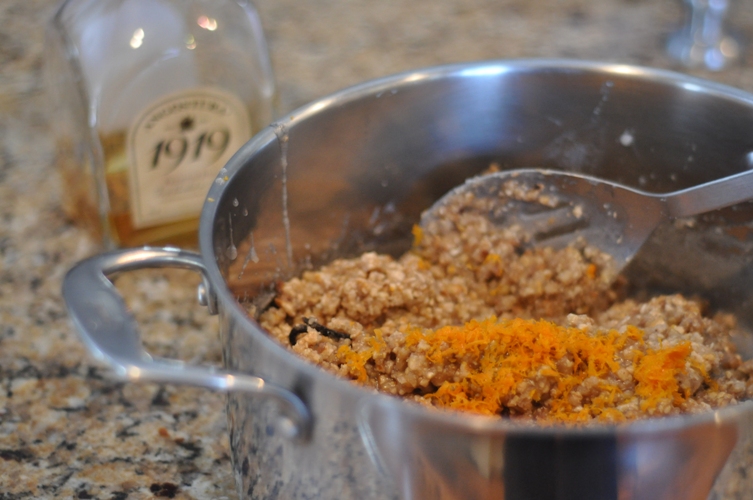
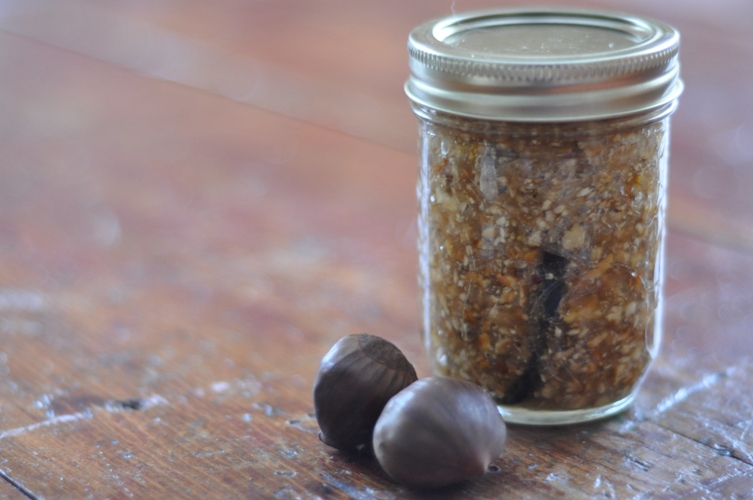
This is not a recipe I will be attempting to perfect now or any time in the future. Chestnuts are relatively expensive and the initial preparation of this spread is time-consuming and difficult. Initially, I was curious about creating this jam/spread as it was unusual and used ingredients that we can only get at this time of year. For now, I’ve satisfied my curiosity. This experiment may be worth repeating if, and only if, you have a glut of nuts that you can get for free and can spend an afternoon doing the tedious job of shelling them with a friend.
Put up Total:
- 5 x 250mL regular mouth mason jars
- Plus, 1 x 250 (2/3 full and unprocessed)
Side Note: this is more for my records than anything else…Jarred the 4th Batch of Fermented Sauerkraut (19lbs).
Put up Total:
- 1 x 1L regular mouth mason jar
- 6 x 1L wide mouth mason jars
- Plus, 500mL unprocessed and refrigerated
Foraging On My Mind
This past autumn was a spectacular time of year for us. Matt and I had put up most of the summer’s bounty, allowing us to turn our attention to foraging the backroads of Muskoka. It seems that there is an endless number of things that can be found if you take time to enjoy the countryside. And, despite experiencing longer winters and a much shorter growing season than areas a 100 kilometers south of here we still have an extensive variety of edible plants and berries.
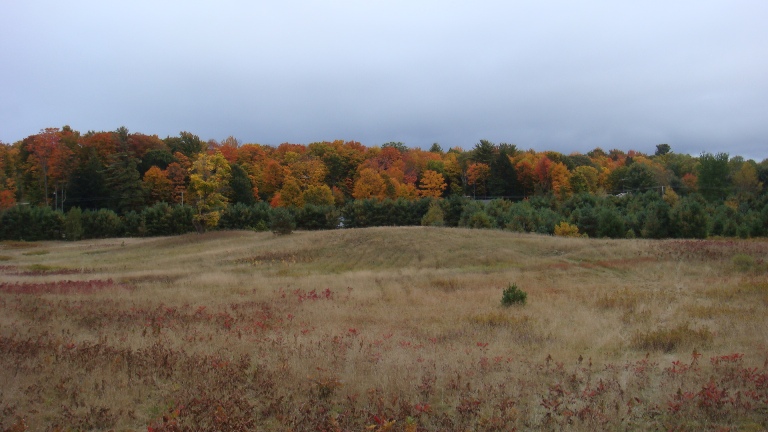
Now, late autumn the foraging in this field is over. But, during the spring and summer months this is a wild edible plant hotspot and provides us with wild leeks, milkweed pods, choke cherries, raspberries, and blackberries.
If you’ve ever foraged before you know how addictive it can become and I’m not really sure why. Maybe, like with so many things “it’s the thrill of the hunt.” There is a seductive sense of mystery created when you start searching for foods to forage. You never know when, where, or what nature is going to offer up and there is an element of surprise lurking around each and every corner. Or, perhaps it goes back to some primal human instinct and the need to collect and gather in preparation for the long winter ahead? Whatever the reason, it is present in both of us. Stumbling upon a patch of wild leeks can send a jolt of excitement through my spine and the fact that we’ve got to walk through knee-deep mud to dig them up only makes it that much more exciting!
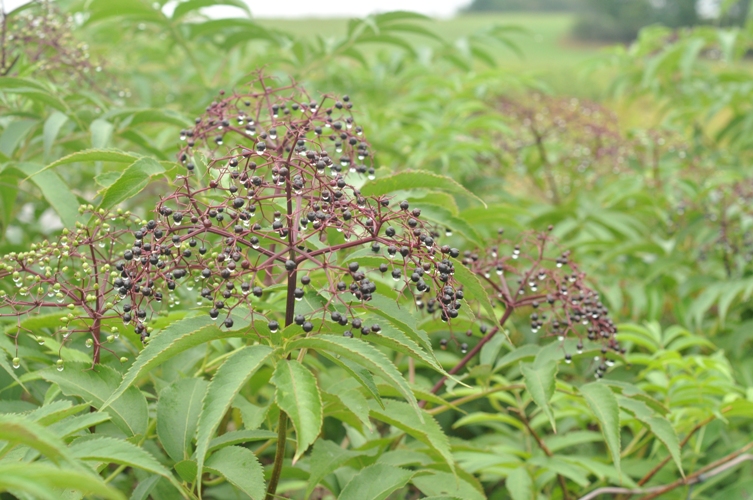
Large Elderberry Bush
Over the course of the summer, we discovered berry ladled elderberry bushes, choke cherries galore, milkweed pod covered fields, wild leeks, not to mention the obvious sumac berries, wild blackberries, crab apples, and rose hips. It was a smorgasbord of deliciousness, all calling out to be responsibly harvested and turned into something we could enjoy until next year.
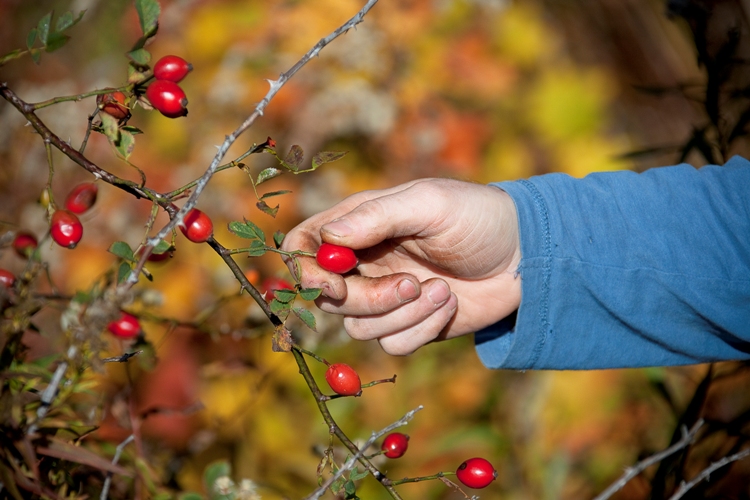
Foraging Rose hips ~ best picked after a good frost...some time in late September. Photograph courtesy of Turnbull Photography.
The truth of the matter is that there just wasn’t enough time to get to everything we found. Matt and I are very conscious of both the environment and our surroundings. It is important when collecting wild edible foods to be both cautious and courtesy.
First, do your homework. Know which plants and berries are edible and which ones may be harmful or even poisonous. There are lots of excellent field guides available that can become useful resources. When looking for books and information on wild foods you will want to make sure the information is specific to the geographical area you forage and that it has lots of photographs that will help you identify each species. Doing some reading before hand and carrying a useful guide will assist you in making educated choices about identification and sustainable harvesting practices. Be aware that many edible plants can look similar to harmful or poisonous varieties. So be sure to be safe!
Second, pick and collect only what you can prepare and be sure that you are doing it in a sustainable manner. If you want to enjoy nature’s bounty for years to come you can not forage endlessly without consequences so learn about sustainable harvesting and be respectful. Sometimes this means collecting only a small amount and moving on or leaving it for another year. It may be helpful to keep track of the areas you forage in a notebook. Record the location, plant or berry species, the size and health of the area/patch, the time/month the food is ready to harvest, as well as the weather conditions from year to year. This information will help you determine the health of the areas you forage as well as where, when, and what you pick each year. For example, this year we experienced a relatively dry summer and as a result our regular wild blackberry patch had very few berries. The previous summer the crop was glutenous and we picked and put up several batches of jam while still leaving tons for the birds and bears. This year we decided it was best left untouched.
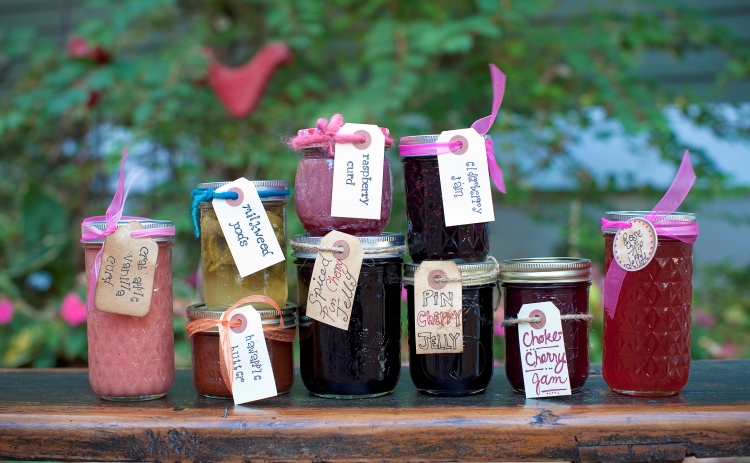
A selection of butters, curds, jams, and jellies that were created from our foraged foods. Photograph courtesy of Turnbull Photography.
I know this post is coming well before the foraging season begins but it might be a great time to get those helpful resources together and decide what you want to look for. With our gardens, fields, and sideroads covered in several feet of freshly fallen snow I can’t help but daydream about getting back outdoors in search of some wild eats. This year, we’d like to expand our foraging adventures and add to our list fiddleheads, sumac berries, and some leafy greens like wild spinach, wood sorrel or chickweed. Knowing what, where, and when to look for wild foods is half the battle.
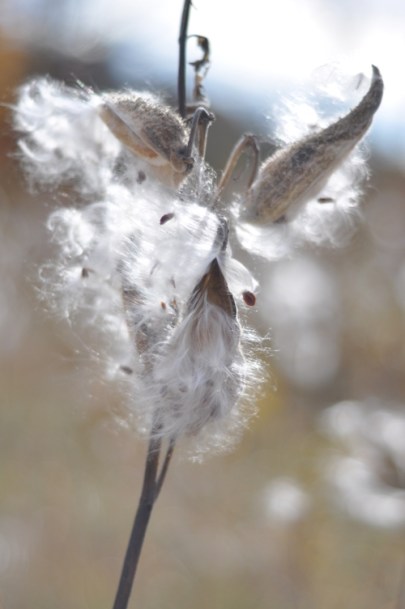
In late summer, fields of blowing milkweed silk give away the location of a potential place to forage the pods.
We’d love to hear about your experiences foraging or if you’ve never foraged before but are curious…tell us about it? Are there any books on wild foods, foraging, or edible plants you can’t live without? When do you do most of your collecting? What do you forage? And, what do you make?
Hazelnuts Preserved in Honey
This recipe is simple and uncomplicated. It requires very little prep work and can be done in less than an hour if you get cracking. There is no water bath, headspace, processing, or jar sealing to worry about. It’s just honey and nuts!

I’ve been meaning to try this recipe from the River Cottage Handbook No. 2 for a while and there is no better time than the present, when I can still get my hands on some nuts. Here, in Northern Ontario an assortment of chestnuts, hazelnuts, pecans, and walnuts are available in bulk and then all of a sudden they’re gone. Why and where they go to I’m not really sure?
I’m not going to complicate this easy recipe by throwing out a whole pile of words about it…so here goes:
RECIPE FOR HAZELNUTS IN HONEY:
- 500 grams or about 5 cups of unshelled hazelnuts
- 340 grams or 1 cup honey (I used palmetto honey from an apiary in Florida)
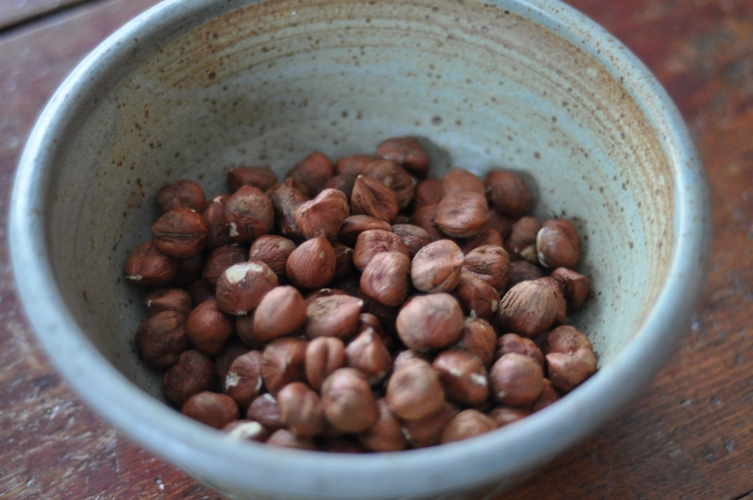
- Crack all of the nuts and discard the shells.
- Thoroughly wash and sterilize 2 x 125mL jars or 1 x250mL jar. We sterilize our jars in the oven at 250F for 30 minutes.
- Heat frying pan on low heat and add shelled nuts. Toast the nuts on low heat for 5-10 minutes making sure they do not burn. This process will remove some of the outer skin; however, the bulk of the nuts maintained their thin outer skin. It may have something to do with the freshness but I’m not sure. If you want to remove all of the outer skin (by that I mean the brown paper-thin covering ~ you could try rubbing the toasted nuts against a metal sieve) I’m not too worried…it is what it is.
- Remove from the heat and allow them to cool.
- Pack the nuts into sterilized jar (Note: allow the jars to cool to room temperature before packing). Alternate the nuts and honey, filling the jars in layers. About 3-4 layers of nuts to 1 tbsp of honey. Don’t worry too much about getting this exact…just be sure that the nuts are well covered in honey and that the jars are full and packed tightly…or, you’ll get floating nuts in honey.
- Seal securely with lid, label and store in a cool dark place for up to 12 months.

These honeyed hazelnuts will brighten up your plain yogurt or be great on porridge but think about using them in some of your baking too!
Put up Total:
- 1 x 250mL reused jar
We also have a bag of chestnuts and wonder what they’d be like preserved in some chestnut honey? If the jam I plan to make doesn’t use up the entire bag of chestnut then I’ll give it a try.
Homemade Granola
The other day I walked into my friend’s home and was bombarded by the most delicious smell. It was sweet, welcoming, and smelt like a home full of love…I can’t quite explain it. I asked “what are you making in here?” She responded, “it’s just some granola” and shared the recipe.
It is an adaptation from The Joy of Cooking and you can make it to suit your tastes. But, believe me it is simple and the smell and taste is out of this world.
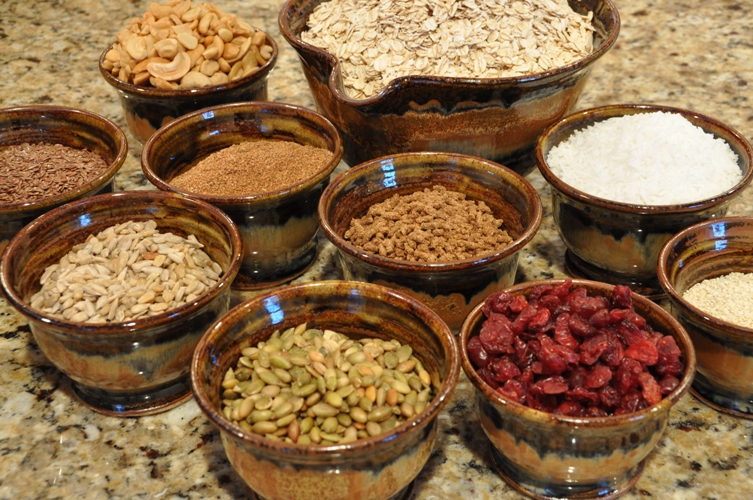
RECIPE FOR HOMEMADE GRANOLA:
- 6 cups rolled oats
- 1.5 cups shredded coconut
- 1 cup wheat germ (optional)
- 2 cups cashew or almond pieces (if using cashews, you can add them after baking)
- 1 cup sunflower seeds
- 1/2 cup sesame seeds
- 1 cup flaxseed
- 1 cup pumpkin seeds
- 1 cup bran (optional)
- 1 tbsp cinnamon (or sometimes I add cocoa)
- 1/2 cup honey
- 1/2 cup olive oil
- 1 cup hot water
- 1 tsp vanilla
- Mix honey and oil with hot water and dissolve in small bowl. Add vanilla.
- In a separate large bowl, mix dry ingredients.
- Combine wet and dry ingredients.
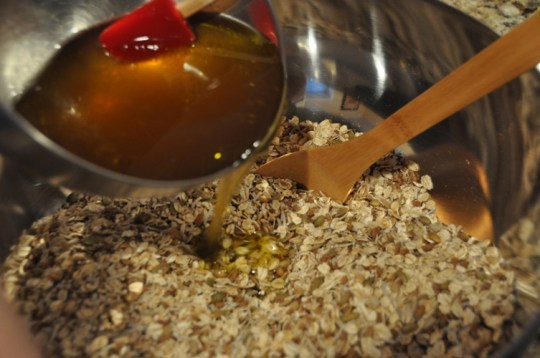
- Spread on 2-3 cookie sheets and roast lightly in 350 degree oven for approx. 20 min. Turn after 10-15min to prevent burning on sides of sheets.
- It is done when lightly browned.
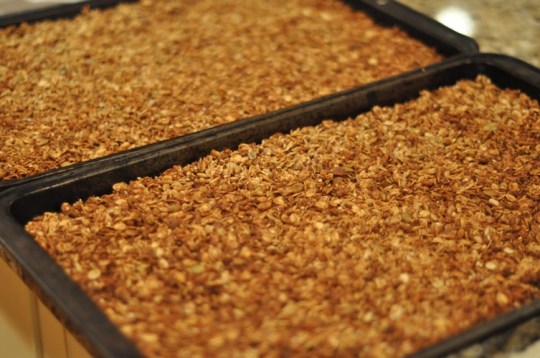
- Sit on counter to cool.
- Add dried cranberries/blueberries/apricots/dates/currants or whatever you have to work with.
- Let cool, then store in an air-tight container at room temperature for up to 5 days or in the refrigerator for up to 1 month.
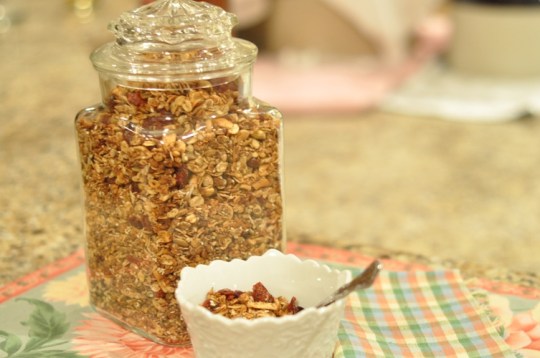
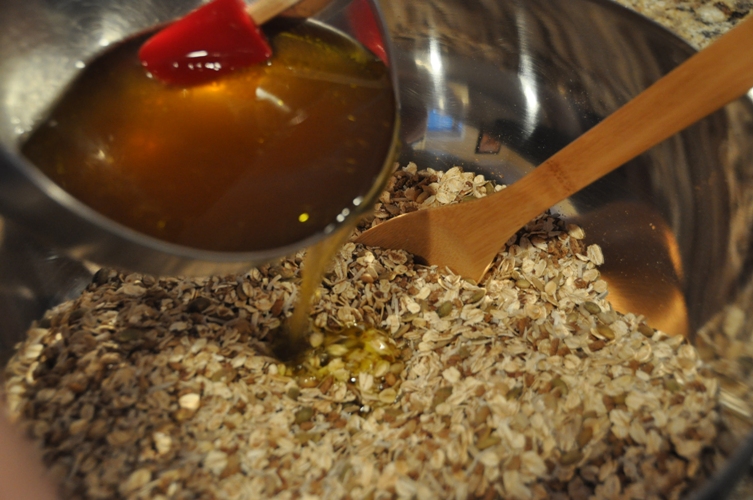
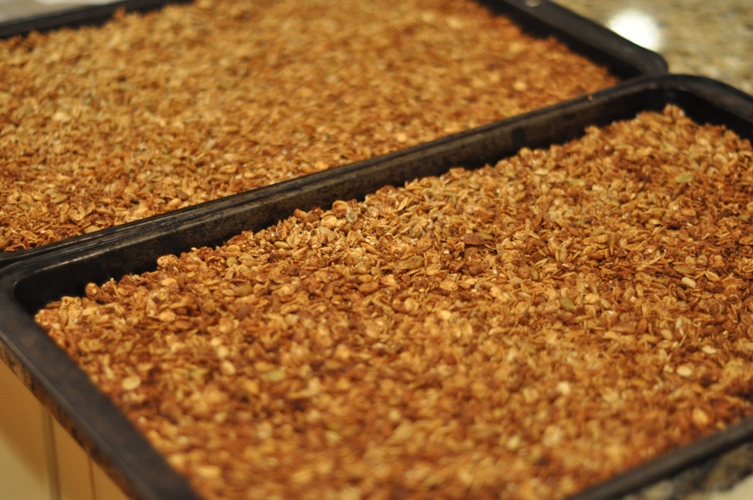
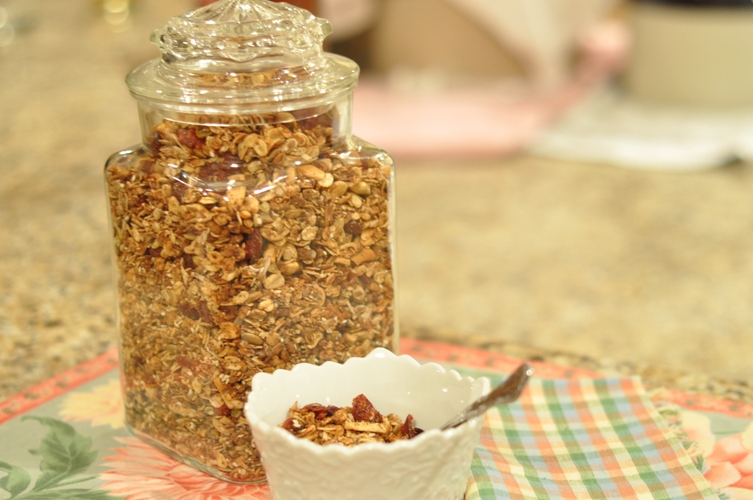
It is seriously simple but oh so delicious. This granola is also a versatile ingredient and can be used for the following:
- In home-baked bread.
- Mixed in with your favorite cake.
- As cereal.
- On top of yogurt.
Okay, you get the hint…
Kimchi ~ A Flavour Explosion
The Kimchi is now in jars after 7 long days of fermenting. It’s been interesting trying something completely NEW to us. In fact, we’ve never tasted Kimchi nor have we ever made it. The process of fermentation is so different from a lot of the other canning and preserving that is done in our home. Most things are jarred in a day or two and three at most. But, fermenting foods can sit on the counter for days just bubbling away…making their magic. The neat thing about this is that you can taste your veggies every step of the way and decide how you like them best.
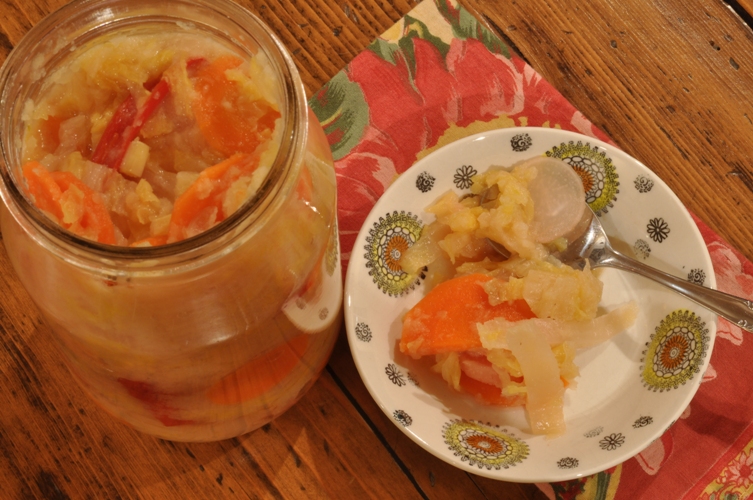
The Kimchi initially tasted really garlicy…we thought that perhaps we’d gone a little over board. But, over the course of the next few days the flavours changed from spicy heat to a salty, more mellow flavour. Matt describes it as a “flavour explosion”.
Your “flavour explosion” should be ready to pack into reuseable jars with tight-fitting lids after about a week. If your home is cool or you are doing this in a cellar the fermentation process may take a little bit longer. Once it tastes ripe it is ready to move to its’ new home in your refrigerator. It should keep for at least 6 months but be warned ~ it does have an addictive taste so we doubt it will last 1 month. Remember the flavour will continue to change with time.
Put up Total:
- 2 x 1L jars (reused mayo jars)
- 2 x 500mL


 Putting Up With The Turnbulls